Thanks Donny, I don't think I've been asking the wrong question though, I understand the wattage value and appreciate your example. The problem I have experienced though is the power source, although having ample wattage't many of the units I've tried don not have the 'power' (amperage) to actually drive the charger and charge the batteries. I have a small 350W inverter in my car and tried to charge two batteries on my six hour drive home from a job yesterday. Checked the charges when I got home (and the charger was running during the entire trip) and nothing... absolutely no increase in the power supply as when I finished the flight. I'm actually a little concerned now that I may have damaged the batteries...
The odds of your batteries being damaged is very slim. Again with the math... Generally speaking, Quick Charging DJI batteries require 180 watts. This is regardless of voltage. The beauty of using Watts instead of Amperage is that the math translates across voltages. Using nice, even numbers, here's an example.
A 20 VDC battery pulling 180 Watts = 9 Amps (180/20=9).
A 90 VDC battery pulling 180 Watts = 2 Amps (180/90=2).
So when you start doing electrical math Amps can be a little complicated because you have to factor in Voltage. Not true with Watts which are constant. Why is this important?
Because you're pulling 180 watts @ the secondary side (DC Voltage to the batteries) then you're pulling 180 watts from the PRIMARY side (AC Voltage at the wall socket).
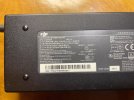
So let's look at your battery charger:
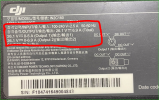
As you can see, at the AC side we're pulling 2.5 Amps. So for 120 Volts that would be 300 Watts (120x2.5=300). So if your car charger is rated @ 350 watts, this means you can only run ONE of your chargers. Did you run one or both of them?
Furthermore, I think if you look closely and read your converter's nomenclature, it will have a "continuous rating" and a "peak rating." Dollars to doughnuts, 350 Watts is peak. And dollars to doughnuts it's "continuous" rating is below 300 watts. If I'm wrong, then I would explore the possibility that your converter is malfunctioning OR lying to you. Chinese offerings almost ALWAYS fudge their specifications.
Remember; your charger is rated for as little as 100 volts. But if it's pulling more current than your inverter is able to supply, you may suffer a brown-out situation where your inverter's supply voltage drops below 100 volts. In this case, your charger would either stop charging OR might malfunction. So, in your case, I would be more concerned about the charger and not the batteries. It's easy enough to test. Does everything go back to working normally when plugged into a wall socket? I would guess YES.
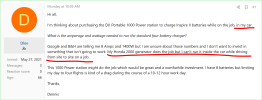
Anyway, the point is that I've tried many chargers (You mean "inverters?") that have the wattage but not the power to drive this charger. I know my 2000W generator works, but not sure a 1000W one would.
Your charger requires 300 watts of power at the wall socket. Your inverter is rated @ 350 watts. Instinctively, you might think that you're in the black. But knowing what I know about inverters and Chinese products in general, I HIGHLY question that rating.
Conversely, the 1,000 watt power supply will source more than enough current for your chargers.
DJI's return policy says that the unit must be unused to return it... Just can't decide if I want to take that gamble or not which is why I started this thread on amperage.
Is there a reason you're stuck on the DJI offerings? Remember, the DJI charger can DIRECTLY charge batteries that are not yours. So the DJI power supply has no advantage over other, cheaper, more powerful offerings.
The charging of ten batteries is kind of a mute [sic] point as I will never be in the field long enough for that to happen.
Copy that.
The DJI charging 'can' only charges two batteries at a time and in an AC wall outlet that takes about 2.5 hours depending on battery depletion.
Then it will take the same 2.5 hours via any power supply you use. Remember this; Either the DJI battery charger will work or it won't. Either there's enough voltage and current supplied to it or there isn't. It won't halfway work because of low voltage or amperage. You either have enough voltage and amperage or you don't. I question your car's inverter. Conversely, the DJI offering or Patriot offerings I suggested earlier WILL have enough of both.
Yes I could get another 'can' and charge four at a time but there just aren't enough hours in the day realistically to charge many more. I don't necessarily fly first thing in the morning each day. One or two sets of extras during the course of the day would probably be plenty.
Touché. The 1,000 watt power supply (rated at 1024 Watt/Hours if memory serves) will be enough for 10 batteries, which appears to be more than you need.
Often I don't even use all four sets that I have - conversely I often don't use all four sets because I am afraid something good might come up that I need another set for, lol.
Makes sense.
So yeah it's a conundrum, spend $500+ for a charger, take up more space in the car, have to drag it up to the room every night to charge it... I don't know, only flew two sets each of the four days I worked this week. It's a tough call and the sale ends at the end of the month. I'd love to be able to test one before I bought it...
The irony is that you have a nice, big, fat 1000 watt/hour battery (depending on brand, type, size, etc.) sitting right there under the hood of your car. A properly-rated boost converter run directly off your car battery would allow you to bypass the inverter AND the DJI charger altogether. It would be nice if DJI made one of those, but they don't.
Thanks again for your insights.
d
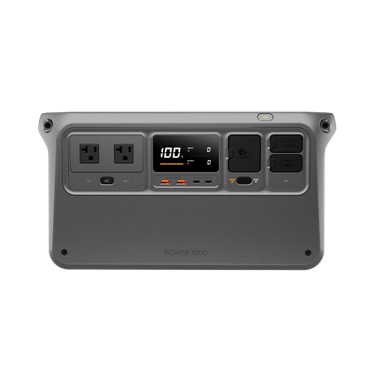
Hue Betchee. In a word, the DJI Power 1000 should work for your needs, albeit, inconvenient to haul around and charge at the end of the day.
D